
 Ayala Herbert
Startups face a tough choice. Security matters, but budgets are tight. Enterprise tools often cost more than the entire engineering payroll.
SonarQube’s Community Build is free. The catch? Self-hosting requires a PostgreSQL database, JVM heap settings with 8 GB minimum for production, and Elasticsearch index management. Operational overhead adds up fast. The paid editions start at $2,500 per year.
The platforms below offer genuine free tiers, open-source licensing, or per-developer pricing that scales with small teams. Each option helps startups secure their code without burning through a limited runway.
1. Aikido
Aikido provides a free forever tier with two users and ten repositories. The all-in-one platform covers SAST, SCA, DAST, secrets detection, container scanning, IaC scanning, and cloud posture management. For startups, this means comprehensive security without paying for multiple tools.
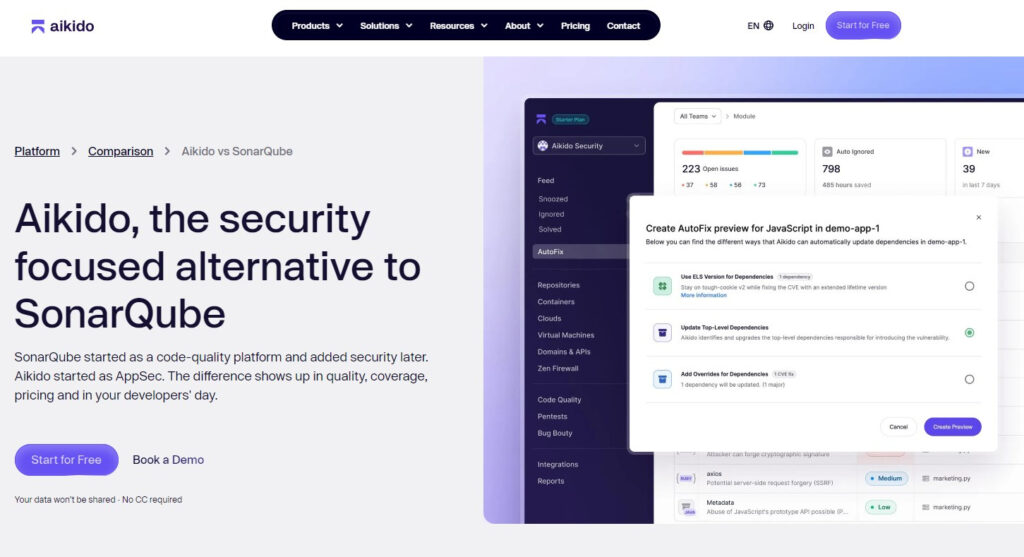
Startups can get started without a credit card. The free tier includes dependency scanning, SAST with AI-powered AutoFix, secrets detection across the SDLC, cloud misconfiguration checks, and license risk tracking. Students can access the full platform for free with a valid school email.
Why startups choose Aikido:
- Free forever tier with 10 repos and 2 users
- No credit card required to start
- Scans run every 3 days on the free plan
- All core security features included at no cost
- Students get full platform access for free with a .edu email
Aikido runs entirely in the cloud. Startups do not need to maintain infrastructure themselves. The platform handles all backend operations automatically. Teams spend time building features instead of patching servers or tuning databases. Security scans run without manual intervention. This makes Aikido a strong SonarQube alternative for startups that want security without operational overhead.
2. Opengrep
Opengrep is the most advanced open-source SAST engine available today. The platform was created when Semgrep moved critical features behind a commercial license. Opengrep keeps static analysis open and accessible to all under the LGPL 2.1 license.
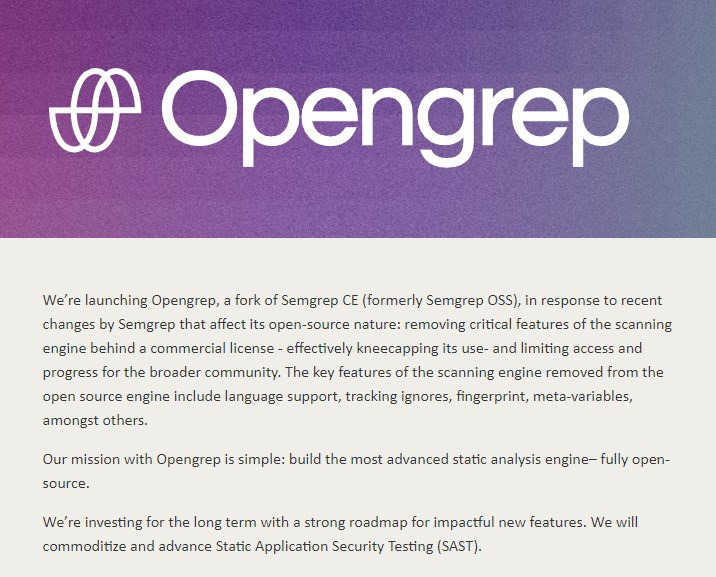
The engine supports 30+ programming languages, including Apex, Elixir, Visual Basic, and Brainf*ck. Taint analysis now tracks constructor and field assignments, inter-method flows, and higher-order functions across 12 languages. Opengrep is backed by a consortium of 10+ AppSec organizations, including Aikido, Arnica, Endor Labs, Jit, Legit, Mobb, and Orca Security.
Why startups choose Opengrep:
- Completely free with no licensing costs
- Compatible with existing Semgrep rules
- Standard JSON and SARIF output formats
- Self-contained binaries with no Python required
- Community-driven development, not commercial interests
For startups seeking affordable options for SonarQube alternatives, Opengrep delivers enterprise-grade static analysis at zero cost. The fast pattern-matching engine analyzes code at speed, helping startups ship securely without slowing down development.
3. FOSSA
FOSSA upgraded its free plan to include security, license compliance, and SBOM management for up to 25 contributing developers and five projects. The free tier includes vulnerability detection and remediation, automated license compliance, and SBOM generation in SPDX and CycloneDX formats.
The free plan is permanent with no scan limits and no credit card required. FOSSA’s container scanning supports the most popular base images, including Debian, Ubuntu, CentOS, Alpine, and Wolfi. The CLI analyzes containers from local Docker installations or OCI-formatted image archives.
Why startups choose FOSSA:
- Free for up to 25 contributing developers
- Unlimited scans with no time restrictions
- No credit card required to sign up
- Automated license compliance included
- SBOM generation for regulatory requirements
- Container scanning for open-source vulnerabilities
For startups comparing SonarQube alternatives for containers, FOSSA provides focused open-source governance without the licensing costs of enterprise SCA tools. The 25-developer limit covers most early-stage startups comfortably.
4. Snyk
Snyk gives individuals and small teams a free plan. Open-source projects get unlimited tests. Private projects get 200 tests per month. That covers most early-stage startups comfortably. The free tier includes SCA, SAST, and container scanning. IDE plugins and CI/CD integration come standard.
Single-click remediation is included. CI/CD pipelines get integrated. Continuous monitoring runs in the background. Open-source projects have no test limits whatsoever. Jira, Jenkins, Slack, GitHub, TeamCity, and Eclipse all work with Snyk out of the box. Team plans start at $25 per user per month for up to 10 contributing developers.
Why startups choose Snyk:
- Free tier for individual developers and small teams
- No limits on open-source project testing
- 200 private project tests per month
- Single-click remediation guidance
- CI/CD pipeline integration included
- IDE plugins for real-time scanning
For startups looking for a developer-friendly SonarQube alternative, Snyk’s free tier provides enterprise-grade security scanning at no cost. The 200 private project tests per month typically cover early-stage startups with limited repositories.
Comparison Table
Each platform serves different startup needs. The table below shows how they compare.
| Feature | Aikido | Opengrep | FOSSA | Snyk |
| Free Tier | 2 users, 10 repos | Unlimited (open-source) | 25 devs, 5 projects | 200 tests/month (private) |
| SAST | Yes | Yes | No | Yes |
| SCA | Yes | No | Yes | Yes |
| DAST | Yes | No | No | No |
| Secrets Detection | Yes | No | No | Yes |
| Container Scanning | Yes | No | Yes | Yes |
| Cloud Posture | Yes | No | No | No |
| Self-Hosted | No | Yes | CLI only | No |
| Credit Card Required | No | N/A | No | No |
| Unique Differentiator | All-in-one free tier | Most advanced open-source SAST | 25 free contributors | 200 free private tests/month |
Free tiers vary significantly across these platforms. Coverage breadth, contributor limits, and deployment models all differ. The right choice depends on team size, security requirements, and infrastructure preferences.
Frequently Asked Questions
Common questions come up when startups evaluate budget-friendly security tools. Here are the most frequently asked ones.
Which platform offers the most comprehensive free tier?
Aikido’s free tier includes 2 users, 10 repositories, and covers SAST, SCA, DAST, secrets detection, container scanning, IaC scanning, and cloud posture management. For startups looking for SonarQube alternatives for cloud and container security, Aikido provides complete coverage at no cost.
Is Opengrep really free?
Yes. Opengrep is open-source under LGPL 2.1. Licensing costs do not apply. Contributor limits are not a concern. Feature gates are not part of the equation. A consortium of 10+ AppSec organizations backs the engine, ensuring long-term maintenance.
What are the limits of FOSSA’s free plan?
FOSSA’s free plan covers up to 25 contributing developers and five projects. Unlimited scans are included. No credit card required. The free tier includes vulnerability detection, automated license compliance, and SBOM management.
How many private tests does Snyk’s free tier include?
Snyk’s free tier includes 200 tests per month on private projects. Open-source projects have no test limits. The free plan includes single-click remediation, CI/CD integration, and continuous monitoring.
Which platform is best for a startup with 10 developers?
Aikido’s free tier covers 2 users, so teams larger than that would need to upgrade. FOSSA covers 25 developers at no cost. Snyk’s free tier works for individual developers. Opengrep has no limits. The best choice depends on which security domains matter most.
What Startups Need to Consider About Free Security Tools
Free tools solve immediate needs. However, startups should consider how these tools will scale as they grow.
Self-hosting costs aren’t free
SonarQube’s Community Build is free software. The infrastructure needed to run it is not. A PostgreSQL database, JVM heap settings with 8 GB minimum for production, and Elasticsearch index management all require engineering time. For startups, time spent maintaining infrastructure is time not spent building product.
Feature gaps matter
Free tiers often limit features, not just usage. Branch analysis and pull request decoration are missing from the SonarQube Community Build. This means issues are discovered after code has been merged rather than during review, when fixes are cheapest.
Contributor limits
FOSSA’s free plan covers 25 developers. Snyk’s free tier limits private project tests to 200 per month. Aikido’s free tier covers 2 users and 10 repositories. Startups should understand these limits before committing.
The upgrade path
Startups that grow need a clear upgrade path. Aikido scales with per-developer pricing. FOSSA’s premium plans remove the 25-developer limit. Snyk’s Team plan starts at $25 per user per month. Opengrep remains free regardless of scale because it is open-source.
Open-source governance matters
Opengrep is backed by a consortium of 10+ AppSec organizations. This governance model provides long-term assurance that the project will continue to be maintained. Community-driven development ensures contributions are accepted on merit, not commercial interest.
For startups comparing SonarQube alternatives, the choice comes down to security coverage, team size, and tolerance for self-hosting overhead. Opengrep offers the most flexibility with no limits. Aikido provides the broadest coverage in a free tier. FOSSA and Snyk serve specific needs with generous free options.
Final Thoughts
Startups need security that scales with their budget. Free tiers and open-source tools make this possible without compromising on quality. The key is choosing platforms that provide real protection without hidden costs.
Aikido offers the broadest free tier covering SAST, SCA, DAST, secrets, containers, IaC, and cloud posture management. Two users and ten repositories are included at no cost. No credit card is required to start. Students get full access with a .edu email. This makes Aikido a strong choice for startups looking for a SonarQube alternative firm with comprehensive coverage.
Opengrep is the most advanced open-source SAST engine available today. Thirty-plus languages are supported. Taint analysis tracks inter-method flows across 12 languages. The engine is backed by a consortium of 10+ AppSec organizations. For startups that want complete control over their tooling, Opengrep delivers.
FOSSA covers 25 developers and five projects at no cost. Vulnerability detection, automated license compliance, and SBOM management are all included. For startups building open-source software or managing complex dependencies, FOSSA provides essential governance.
Snyk’s free tier gives individual developers 200 private project tests per month. Open-source projects have unlimited tests. CI/CD integration, IDE plugins, and single-click remediation are included. For startups in early stages, Snyk offers a path to professional security scanning.
Among all-in-one SonarQube alternatives to consider, Aikido’s free tier stands out for its breadth. Opengrep serves teams that prefer open-source governance. FOSSA covers dependency management at scale. Snyk supports individual developers. The best choice depends on team size, security requirements, and infrastructure preferences.